Materials and construction
What the shell must withstand
An electric board hull floats a rider, protects a high-energy battery, carries drive loads and survives repeated slamming. Materials and sealing are engineering choices with direct safety consequences.
Slamming
Repeated impacts landing in chop or after a foil breach.
Point loads
Feet, mast mounts and fin boxes concentrate stress.
Environment
UV, salt, sand and temperature swings attack resins and seals.
Heat
Motors and controllers must shed heat without cooking the battery.
Four jobs in one hull
A conventional surfboard has one main task: provide the right buoyancy and shape. An electric board adds three more. It has to house a battery that may hold well over a kilowatt-hour of energy, keep water away from electronics, and transmit thrust and lift loads from the drive into the rider's stance. A construction that excels at one job can compromise another, so weight figures alone tell you little.
Composite skins: carbon, glass and resin
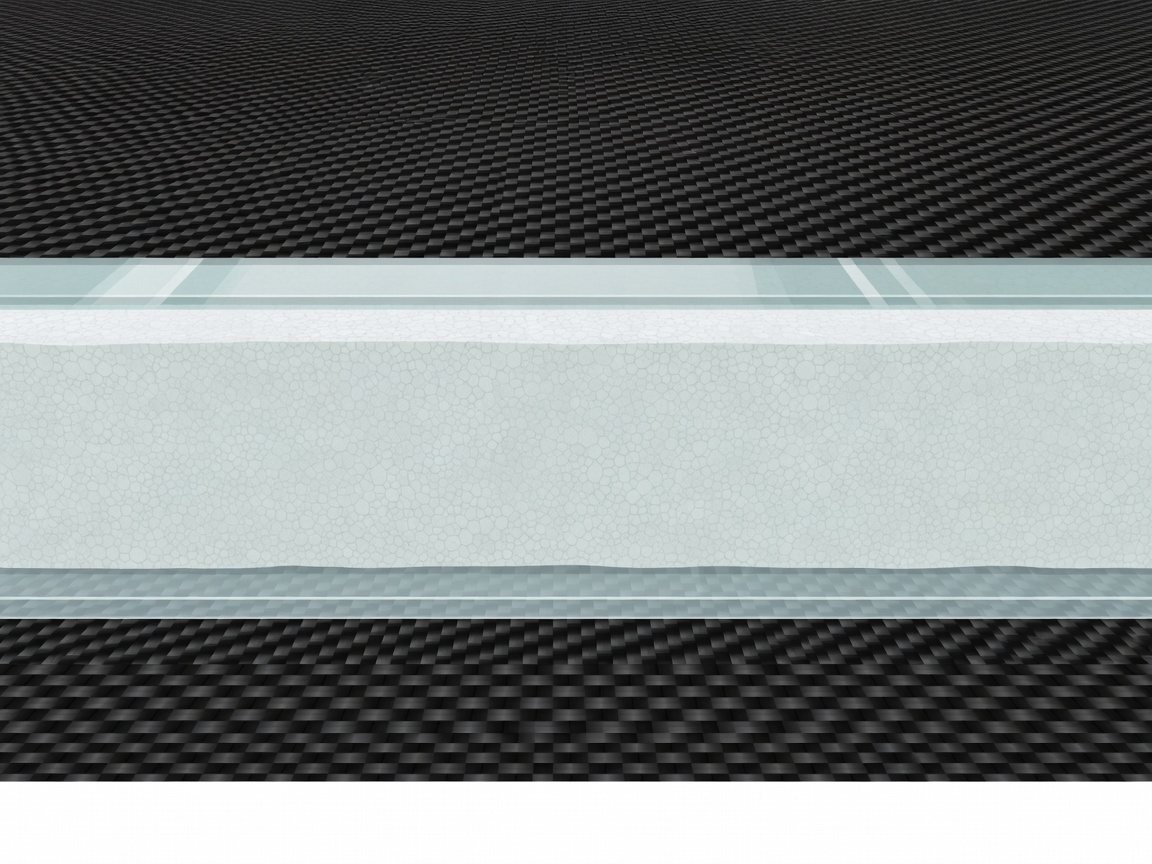
Most premium boards use fibre-reinforced composites. Carbon fibre is stiff and light; glass fibre is heavier but more impact-tolerant and less expensive. Both are bound in epoxy resin. Prepreg carbon, cured under heat and pressure, gives consistent fibre-to-resin ratios, while wet layups depend more on workshop skill. "Full carbon" on a spec sheet does not reveal ply count, fibre orientation or how impact zones such as rails and nose are reinforced. Ask how the board resists dings, not only how light it is.
Some boards use rotomoulded or blow-moulded thermoplastic shells. These are heavier, but they tolerate knocks well and can suit rental fleets and schools where durability outweighs performance.
Cores and buoyancy
Between composite skins sits a core, commonly expanded polystyrene (EPS) or PVC foam. In a sandwich structure, the core separates the skins so the panel is stiff for its weight, much like an I-beam. Closed-cell foams resist water uptake, which matters if a skin is damaged. Volume, expressed in litres, determines how well the board floats a rider at rest, and matters most at low speed and when starting from the water.
Battery bays and sealing
The battery bay is the most safety-critical cavity in the board. It is usually closed by a lid with a compressible gasket and latches, or the battery itself is a sealed module dropped into a recess. Seals must cope with flex, temperature changes and grit. Sand on a gasket is a common cause of leaks, which is why cleaning sealing surfaces belongs in every pre-launch routine.
Connectors carry high currents and must stay dry and corrosion-free. Look for documentation on connector type, sealing method and recommended lubricants for O-rings.
Understanding IP ratings
Ingress protection codes come from IEC 60529. The second digit describes water resistance: IP67 means protection against temporary immersion, tested at up to one metre for 30 minutes; IP68 means protection beyond that, under conditions specified by the manufacturer. Two cautions apply. A rating usually applies to a component, such as the battery or the remote, not the whole board. And it is tested on new, correctly closed equipment, not on a ten-month-old seal with sand on it.
Heat management
Motors and speed controllers produce heat under load. Many designs place them where water flows past, through the drive duct, the mast pod or dedicated cooling channels. Batteries prefer moderate temperatures; heat from electronics or a dark deck in strong sun can push them towards protective cut-off. Store boards in shade between sessions.
Repairs and inspection
Small dings in composite skins should be dried and repaired promptly, because water reaching the core adds weight and can delaminate the skin. Any crack near the battery bay, mast mount or drive housing deserves professional assessment. Check whether the manufacturer approves third-party repairs, as warranties often exclude them.
Questions to ask
- Which components carry which IP rating, and how was it tested?
- How are rails, nose and mast mounts reinforced?
- What is the board volume, and for what rider weight is it designed?
- Is impact damage covered by the warranty, and who can repair it?
A well-built board still needs a prepared rider. Continue with safety equipment and care.